
In Shingon Esoteric Buddhism, which the Great Master Kōbō Daishi brought to Japan, there are many Buddhas and Bodhisattvas residing within the mandala.
While many of these sacred beings extend a hand of salvation in response to individual wishes, there are also Buddhas who offer healing and tranquility not for any particular person, but to the world itself.
These are the Eight Offering Bodhisattvas (Hakkuyō Bosatsu).
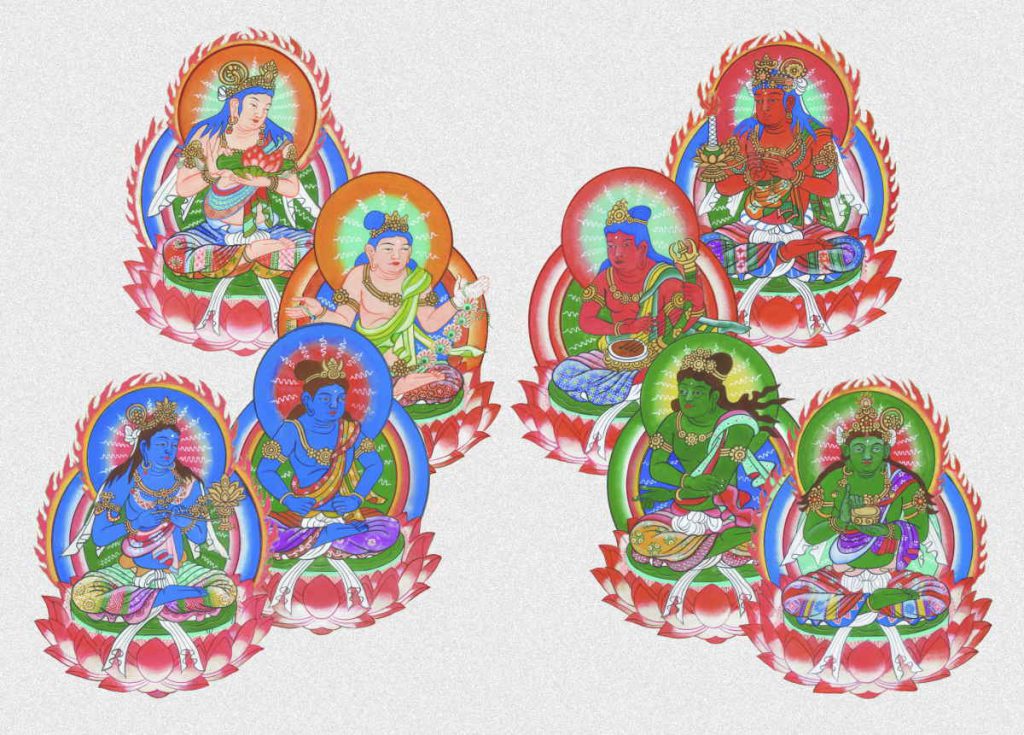
Bearing the names Joy, Garland, Song, Dance, Incense (Burning Incense), Flowers, Light, and Perfume (Anointing Incense), these Bodhisattvas adorn and heal the world through song and dance, flowers and fragrance.
The Eight Offering Bodhisattvas may be unfamiliar to lay practitioners.
However, for monks who perform esoteric Buddhist rites, they are indispensable. Alongside the offering of actual flowers and lamps (physical offerings, ji-kuyō), the chanting of the mantras of the Eight Offering Bodhisattvas as offerings of the mind (spiritual offerings, ri-kuyō) is almost invariably practiced. Thus, they are essential figures in Esoteric Buddhism.
In Reiwa 5 (2023), marking the 1250th anniversary of the birth of Kōbō Daishi, eight Shingon Buddhist temples in the western region of Tokushima Prefecture, within the Miyoshi area, came together to invite the Eight Offering Bodhisattvas. With the aspiration of “removing suffering and bestowing joy,” they established Japan’s first pilgrimage dedicated to these Bodhisattvas: the Shikoku Awa Eight Offering Bodhisattvas Sacred Site.
Since the true nature of “suffering” lies in the mental movement of things not going as one wishes, this pilgrimage seeks to help practitioners form a sacred connection with the Eight Offering Bodhisattvas. Through spiritual offerings made with the heart, one departs from suffering and attains peace of mind—this is the aspiration of “removing suffering and bestowing joy” held by this sacred site.
The assignment of the temples within this sacred site was inspired by the resemblance between the positions of the Eight Offering Bodhisattvas in the Vajradhātu Mandala and the geographical arrangement of the eight temples situated along the Yoshino River.
Accordingly, the Eight Offering Bodhisattvas were assigned as follows:
The Four Inner Offerings (Nai no Shiku-yō)
Kongō Ki Bodhisattva (Joy) — Chōraku-ji Temple
Kongō Man Bodhisattva (Garland) — Fudō-in Temple
Kongō Ka Bodhisattva (Song) — Hashikura-ji Temple
Kongō Bu Bodhisattva (Dance) — Ganjō-ji Temple
The Four Outer Offerings (Ge no Shiku-yō)
Kongō Kou Bodhisattva (Incense)— Jifuku-ji Temple
Kongō Ke Bodhisattva (Flower)— Renge-ji Temple
Kongō Tou Bodhisattva (Light)— Mitsugon-ji Temple
Kongō Zu Bodhisattva (Perfume)— Rurikō-ji Temple

In this manner, the Eight Offering Bodhisattvas were ceremonially assigned to the eight temples of the pilgrimage.
When the directions are aligned, Chōraku-ji (means temple of Long comfort) to correspond with Kongō Joy Bodhisattva, and Renge-ji(means temple of Lotus) with Kongō Flower Bodhisattva, giving rise to a sense of mysterious guidance at work.
By forming a sacred connection with these Eight Offering Bodhisattvas, we sincerely hope that, in a world that does not always unfold as one wishes, all who visit may be granted healing and peace of mind.
Googleマイマップ